Important note: This post is a discussion of one of the claims (claim in title) made in my book The Human Holographic Visual System. To learn more of how the retina and other components of the visual system function, read my book. It is available in hardback, paperback, and e-book formats at Amazon, Barnes and Noble, and Bookshop.
Holography requires fully coherent light waves to function. To be fully coherent, light waves must be spatially coherent and temporally coherent. The eyes produce fully coherent light waves in two steps.
- 1st step: As the light waves enter the eyes, the irises/lenses of the eyes act as an adjustable pinhole apertures that produce spatially coherent visible light waves. Inside the eye, the spatially coherent visible light waves strike the retinas.
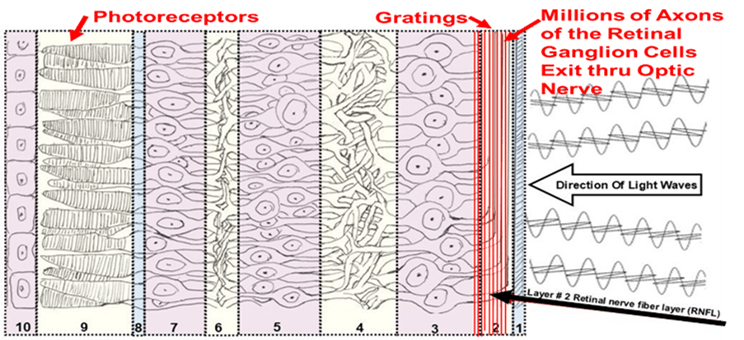
- 2nd step: In the second layer of the retinas, the light waves strike the retinal nerve fiber layer that acts as a transmissive diffraction grating device separating the spatially coherent visible light into its component wavelengths.
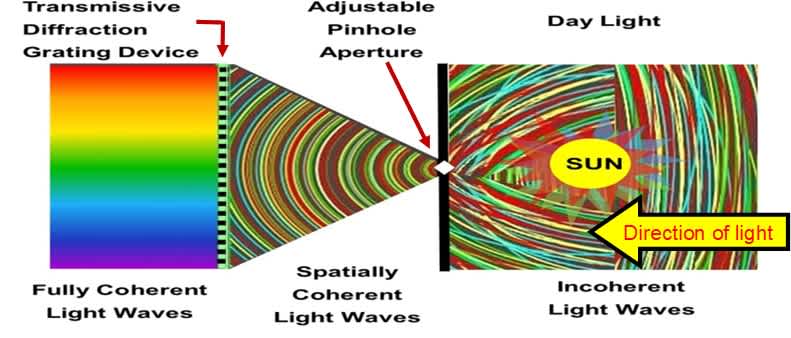
The retinal nerve fiber layer has millions of axons of the retinal ganglion cells that are architecturally structured to act as a transmissive diffraction grating device. As the light waves go through the diffraction gratings, the action separates spatially coherent light into red, green, blue, and neutral-color wavelengths and makes the spatially coherent light into fully coherent light waves. Also, this process produces interference patterns for each wavelength the retina separates.
To learn more, read my book The Human Holographic Visual System. The book is available in hardcover, paperback, and e-book formats at Amazon, Barnes and Nobles, and Bookshop.